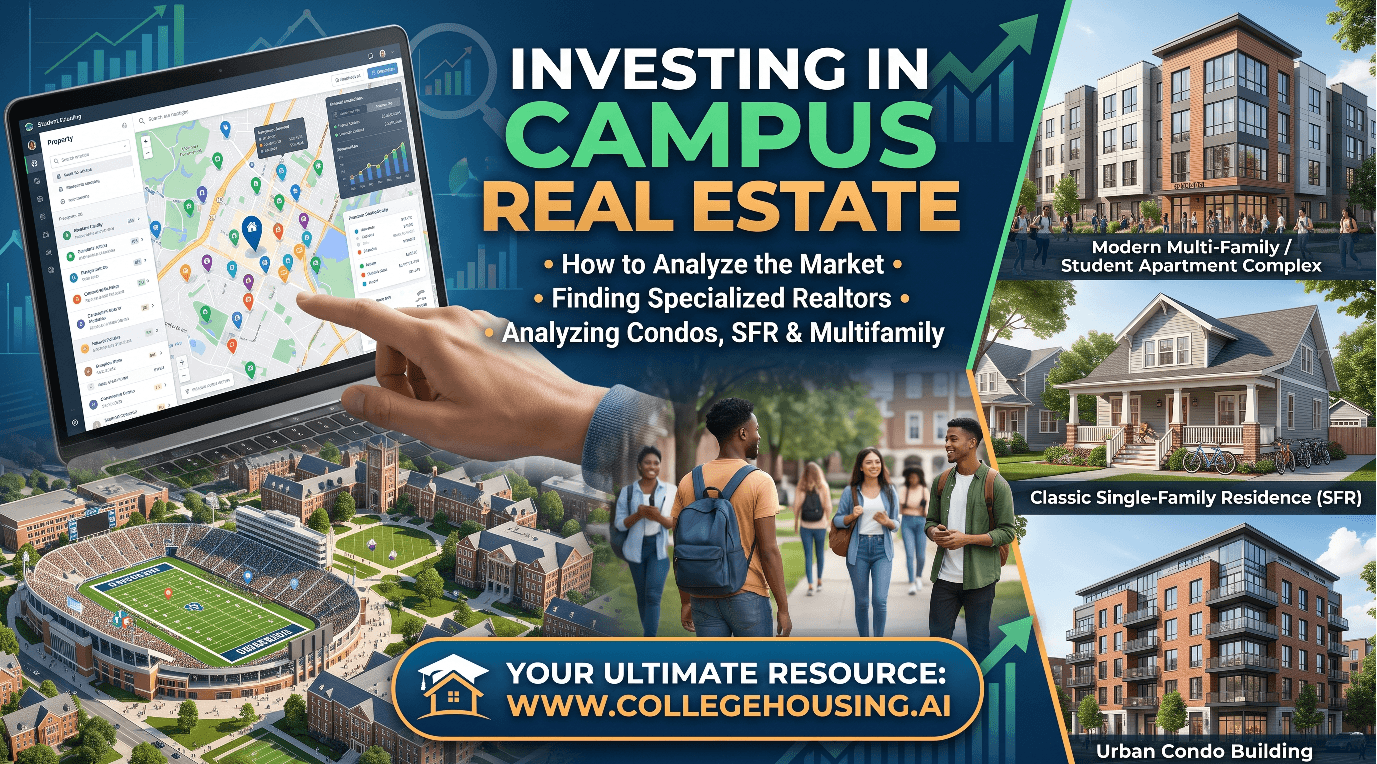
The Investor’s Guide to Campus Real Estate: Market Analysis, Property Types, and Building Your Local Team
Investing in student housing offers one of the most resilient cash-flow opportunities in real estate. Unlike traditional residential rentals that rise and fall with local job markets, university-anchored markets benefit from a built-in, recurring pool of tenants every academic year. However, campus real estate operates on its own set of rules—from academic leasing calendars to per-bed pricing models.
To build a profitable student housing portfolio, you need to master market fundamentals, evaluate the right asset classes, and partner with specialists who know the campus landscape inside and out. Platforms like www.collegehousing.ai make this process significantly easier by giving investors data-driven market insights and direct access to local campus real estate experts.
How to Analyze College Campus Real Estate
Before looking at a single listing, you have to underwrite the university itself. Understanding how to analyze college campus real estate comes down to measuring supply, demand, and hyper-local geography:
- Enrollment Trends vs. On-Campus Bed Supply: Look for universities with steady or growing enrollment where on-campus dormitories cannot house the entire student body. If a school requires freshmen to live on campus and pushes sophomores through seniors into the private market, off-campus demand is structurally locked in.
- The Proximity Radius: In student housing, distance to campus dictates both rent premiums and vacancy risk. Properties within a 10-to-15-minute walk or directly on a university shuttle route consistently lease faster and retain value better than properties requiring a daily commute.
- Per-Bed vs. Per-Unit Economics: Conventional rentals are underwritten by the unit, whereas student rentals are often priced per bed. A four-bedroom property rented individually at $850 per bed generates $3,400/month—often 20% to 40% more than a traditional family lease on the same floor plan.
- Local Zoning and Occupancy Caps: Many college towns enforce strict "unrelated-person" ordinances (e.g., capping occupancy at three or four unrelated tenants per single-family home). Always verify municipal codes before assuming you can maximize bedroom counts.
- The Pre-Leasing Calendar: Student housing leases typically run from August to July, with pre-leasing starting as early as October or November of the prior year. Missing the spring leasing window can leave a property vacant for an entire academic cycle.
For investors looking to streamline this due diligence, www.collegehousing.ai provides specialized market data and analytics tailored specifically to university submarkets—helping you compare rent-per-bed benchmarks, walkability scores, and enrollment dynamics in one place.
How to Analyze Property Types: Condos, SFR, and Multifamily
Not every property performs the same way near a university. Knowing how to analyze property types—condos, SFR (single-family residences), and multifamily—allows you to match your capital and management style to the right asset.
| Property Type | Best For | Key Underwriting Metrics | Primary Pros & Cons |
| Condos | First-time investors, "kiddie condo" buyers, lower capital entry | HOA fees, special assessments, rental cap rules in HOA bylaws | Pros: Low exterior maintenance, shared amenities.
Cons: HOA fees eat into cash flow; boards can restrict student rentals. |
| Single-Family Residences (SFR) | Cash-flow investors maximizing bedroom-to-bathroom ratios | Cost per bed, unrelated-occupant zoning limits, annual turn/repair budget | Pros: Strong appreciation, high per-bed rent potential, easy exit strategy to traditional buyers.
Cons: 100% vacancy if a group backs out; higher wear and tear. |
| Multifamily (2–20+ Units) | Scaling investors seeking economies of scale and institutional financing | Net Operating Income (NOI), Cap Rate, pre-leasing velocity, per-bed expense ratio | Pros: Diversified vacancy risk across multiple doors; centralized maintenance and management.
Cons: Higher upfront capital; fierce competition near tier-one campuses. |
Deep-Dive Takeaways by Asset Class
- Condos: Always read the HOA covenants before making an offer. Even if a building sits across from campus, a rule prohibiting leases under 12 months or capping investor-owned units can kill your deal. Factor HOA dues directly into your monthly expense ratio.
- Single-Family Residences (SFR): Look for layouts with equal-sized bedrooms and a high bathroom-to-bedroom ratio (ideally 1:1 or 1:2). Students rarely want to share a single bathroom among four roommates, and en-suite bathrooms command noticeably higher per-bed rents.
- Multifamily: Focus on durability and turnover efficiency. Properties with luxury vinyl plank flooring, solid-core doors, and standardized appliances dramatically reduce your annual "turn" costs during the chaotic late-July move-out/move-in window.
How to Find Realtors That Specialize in Campus Real Estate Investment
A traditional residential agent who focuses on suburban family homes will often miss critical nuances in a college market—such as pre-leasing timelines, parental guarantor norms, or micro-neighborhood preferences. Knowing how to find realtors that specialize in campus real estate investment is one of your biggest competitive advantages.
When vetting an agent in a college town, look for these indicators:
- Fluency in Per-Bed Underwriting: They should immediately speak in terms of rent per bed, cap rates, and turn costs rather than just comparable sales prices.
- Off-Market Deal Flow: Many campus properties trade quietly between local landlords before ever hitting the MLS. An active student-housing broker maintains relationships with retiring mom-and-pop owners.
- Vendor and Property Management Network: Campus investing requires rapid maintenance during August turns and reliable student-focused property managers. A strong local realtor will connect you with vetted contractors, lenders familiar with student-housing underwriting, and specialized managers.
Instead of cold-calling general brokerages, you can use www.collegehousing.ai to connect directly with local experts who specialize in university real estate markets, ensuring you have an on-the-ground partner who understands the specific campus you are targeting.
Putting Your Campus Investment Strategy Into Action
Successful student housing investing comes down to combining disciplined underwriting with hyper-local execution. Start by identifying a university with strong enrollment fundamentals, compare whether a condo, SFR, or multifamily asset fits your budget and risk tolerance, and align yourself with a specialist who knows the neighborhood block by block.
Ready to start evaluating your target university market? Visit www.collegehousing.ai to analyze local campus housing data and connect with specialized real estate professionals in your market.