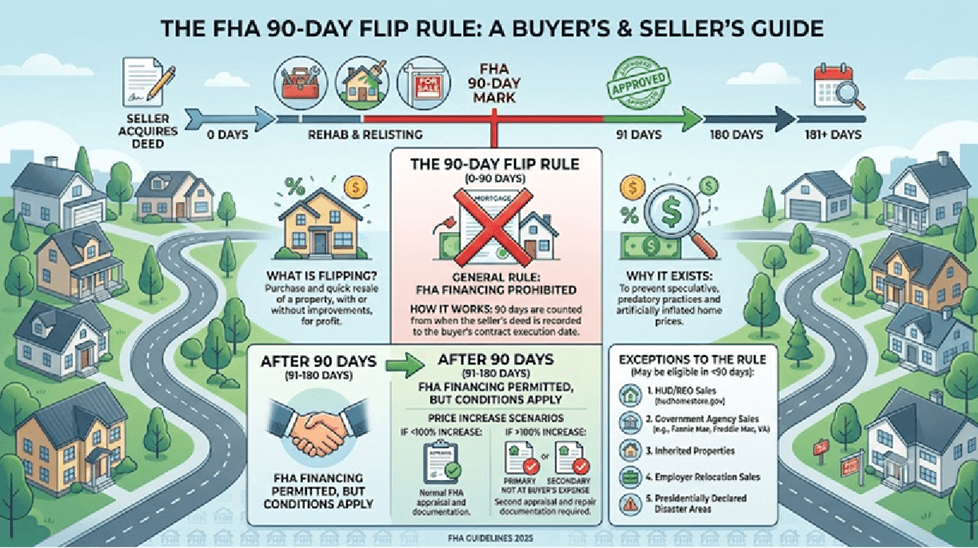
You found a great deal on a recently renovated home, but your lender says FHA won't finance it because of "flipping rules." What does that mean, and is there any way around it?
Here's everything you need to know about FHA's property flipping restrictions — when they apply, the exceptions, and how to navigate them.
Property flipping is when an investor purchases a property, typically makes improvements, and resells it for a profit in a short period of time. There's nothing inherently wrong with flipping — it can improve neighborhoods and housing stock.
However, FHA has rules designed to protect borrowers from:
These rules create waiting periods and additional documentation requirements for recently sold properties.
Reference: HUD 4000.1, Section II.A.1.b.ii — Property Flipping
FHA will not insure a mortgage on a property if the seller has owned it for less than 90 days.
How it's calculated:
The 90 days is measured from:
Example:
What happens if you're under 90 days:
The loan is simply ineligible for FHA insurance. No exceptions, no workarounds (with limited exceptions discussed below). You'd need to wait, use a different loan program, or walk away.
Once the property passes the 90-day mark, FHA will consider insuring the loan, but if the resale price is significantly higher than what the seller paid, additional requirements kick in.
The trigger: Resale price is 100% or more over the seller's acquisition cost.
In other words, if the seller is trying to sell for more than double what they paid, FHA requires extra scrutiny.
Additional requirements when resale is 100%+ above acquisition:
Example:
If the resale is less than 100% above acquisition:
No second appraisal is automatically required, though the lender can still order one if the circumstances warrant additional scrutiny.
For any property resold within 12 months of acquisition (even after the 90-day period), the lender should be alert to potential issues and may need to document:
Legitimate reasons for quick resale:
Red flags that trigger additional review:
There are specific situations where the 90-day restriction does not apply:
Properties acquired by HUD through foreclosure and resold through HUD HomeStore (hudhomestore.gov) are exempt from the 90-day rule.
Why: HUD already owns these properties and sells them through a regulated process.
Sales by:
These are exempt because the government entity is the seller, and the transaction is already subject to oversight.
When an employer or relocation company acquires a property as part of an employee relocation, the 90-day restriction doesn't apply.
Documentation required:
Certain HUD-approved nonprofit organizations that acquire properties for rehabilitation and resale are exempt.
In areas with a Presidential disaster declaration, the 90-day rule may be waived to facilitate housing recovery.
New construction sold by a builder is exempt. The builder doesn't have to wait 90 days after acquiring the lot to sell the completed home.
Key distinction: This applies to new construction, not gut rehabs of existing structures.
Getting the timeline right is critical. Here are the specifics:
Seller's acquisition date:
This is the date the seller's deed was recorded, not the date they signed the contract or closed. Check the recorded deed in public records.
Contract execution date:
This is when the buyer (you) signs the purchase agreement, not when the offer is submitted or accepted verbally.
What counts as "acquisition":
What if the seller acquired via land contract or lease option?
The 90 days starts from when the seller received the deed, not when they started the land contract or lease option.
Situation:
Options:
If you write a contract dated before day 90, the loan is ineligible. Period.
Situation:
What happens:
If the appraisals support the value, you're fine. If they don't, you have a problem.
Situation:
What happens:
Situation:
What happens:
When a second appraisal is required (resale 100%+ above acquisition within 91-180 days), here's how it works:
Who pays: The lender pays for the second appraisal. This cost cannot be passed to the borrower.
What appraiser is used: Must be a different appraiser than the first one.
What if the appraisals disagree:
Impact on timeline: Second appraisals add time to the process. Plan for delays if you're in this situation.
Before making an offer on a recently renovated property, verify how long the seller has owned it:
Public records search:
Ask your real estate agent: They should pull the ownership history before you write an offer.
What to look for:
Q: Can I get around the 90-day rule by dating my contract later?
A: The contract must be legitimately executed on that date. Backdating or falsely dating a contract is fraud. Lenders verify the timeline.
Q: What if the seller did a quit claim deed to themselves to restart the clock?
A: This doesn't work. FHA looks at when the seller acquired the property from a different party. Internal transfers don't restart the 90-day clock.
Q: Does the 90-day rule apply to refinances?
A: No. The flipping rules apply to purchases, not refinances. If you already own the property, you can refinance anytime (subject to other seasoning requirements for specific loan types).
Q: What if I'm buying from a family member who just inherited the property?
A: Inheritance acquisitions are treated the same — the 90-day clock starts when the heir's deed was recorded. However, some lenders may be more flexible documenting that no flipping scheme is involved.
Q: My agent says the seller is a builder. Does the 90-day rule apply?
A: If it's genuinely new construction, the 90-day rule doesn't apply. If the "builder" bought an existing structure and renovated it, the rule applies. The distinction matters.
Q: What if the appraisal supports the price but the second appraisal doesn't?
A: The lender typically uses the lower value. You'd need to renegotiate, bring additional cash to closing, or walk away.
Q: Can I buy a home from a wholesaler who is "assigning" the contract to me?
A: Generally, no. FHA requires the seller on the contract to be the owner of record. If the wholesaler never actually took title (recorded the deed in their name), FHA will flag this. The "flip" clock starts when the owner of record acquired the title.
Understanding why these rules exist helps you navigate them:
FHA's perspective: Rapid resales at high markups have historically been associated with fraud — inflated appraisals, poor quality work, and borrowers getting stuck with overpriced homes that later go into foreclosure.
The tradeoff: These rules protect borrowers but also limit access to some properties. A legitimately renovated home might be a great deal, but FHA's blanket rules don't distinguish between good actors and bad actors.
The market reality: Many flippers price their work knowing FHA buyers will be excluded for the first 90 days. They either target conventional/cash buyers or hold properties until day 91.
| Timeline | FHA Eligibility | Requirements |
|---|---|---|
| Day 0-90 | NOT ELIGIBLE | No FHA financing available |
| Day 91-180, resale <100% above acquisition | Eligible | Standard appraisal |
| Day 91-180, resale ≥100% above acquisition | Eligible | Second appraisal required (lender's expense) + improvement documentation |
| Day 181+ | Eligible | Standard appraisal |
Exceptions to 90-day rule:
Drop them in the comments. Property flipping questions come up regularly — if you're looking at a recently renovated home and aren't sure about the timeline or requirements, share the details and I can help you figure out whether FHA will work.
This guide is for educational purposes and reflects general FHA guidelines per HUD 4000.1, Section II.A.1.b.ii. Individual lenders may have overlays beyond FHA minimums. Always verify current requirements with your loan officer.
Our representative will be in touch with you.