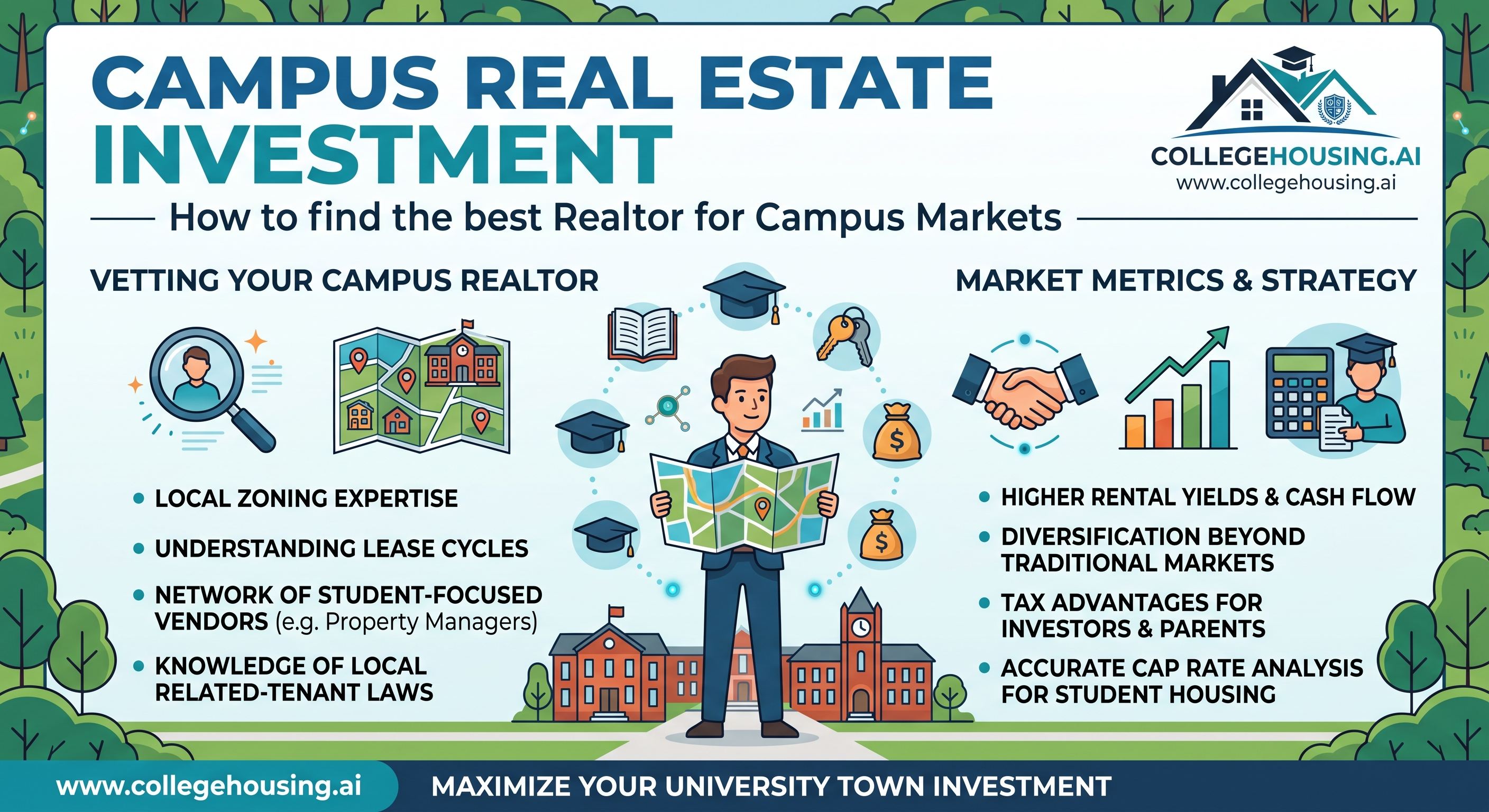
Investments in college town real estate carry unique dynamics: high, predictable demand coupled with localized regulations, distinct lease cycles, and elevated tenant turnover.
Partnering with an agent who understands standard suburban single-family homes is rarely sufficient for navigating a campus submarket. Securing a agent who specializes in university-area real estate is a critical step in maximizing cash flow and protecting asset value.
College town real estate differs substantially from traditional residential markets in several operational and financial areas:
To locate a top-performing agent in a college market, look for expertise in five specific domains:
A specialized agent knows local zoning designations down to the specific street. They should instantly tell you whether a property is zoned for multi-tenant student use, if it falls under historical district restrictions, or if a city requires annual rental registration inspections.
Ask prospective agents when local students typically shop for housing. A qualified local expert will know if the market operates on an August-to-July cycle, if leases are signed 9 months in advance (as in many Tier-1 university towns), or if joint-and-several liability clauses are standard practice for local parents co-signing leases.
A student housing investor needs more than an agent—they need an ecosystem. A top-tier Realtor brings a vetted bench of local professionals:
Campus markets attract two distinct buyers: long-term yield investors and parent buyers looking to house their child while offsetting costs through extra bedroom rentals.
A specialized agent should evaluate properties by income potential, not just square footage. They should readily provide local rental benchmarks per bed/bedroom, occupancy averages, and realistic gross yield projections.
When interviewing agents serving university markets, ask these targeted questions:
| Evaluation Area | Key Question to Ask | What You Want to Hear |
| Zoning Knowledge | "What are the local ordinances regarding maximum unrelated occupancy in this neighborhood?" | A precise answer citing specific city codes, parking requirements, and rental license processes. |
| Leasing Cycles | "What month does the peak signing season begin for off-campus housing here?" | A clear breakdown of the local student leasing calendar and turn-period dynamics. |
| Financing & Yield | "Do you work with lenders familiar with DSCR loans or parent-purchase co-signing strategies?" | Direct connections with lenders experienced in university-market financing. |
| Track Record | "How many campus-adjacent transactions have you completed in the past 12 months?" | A proven portfolio of transactions within 1 to 3 miles of campus. |
Vetting real estate agents in unfamiliar college towns can be time-consuming.
Rather than relying on generic agent directories,
Whether evaluating a parent-owned home for an incoming student or acquiring an income-producing multi-family property, partnering with a verified local specialist through