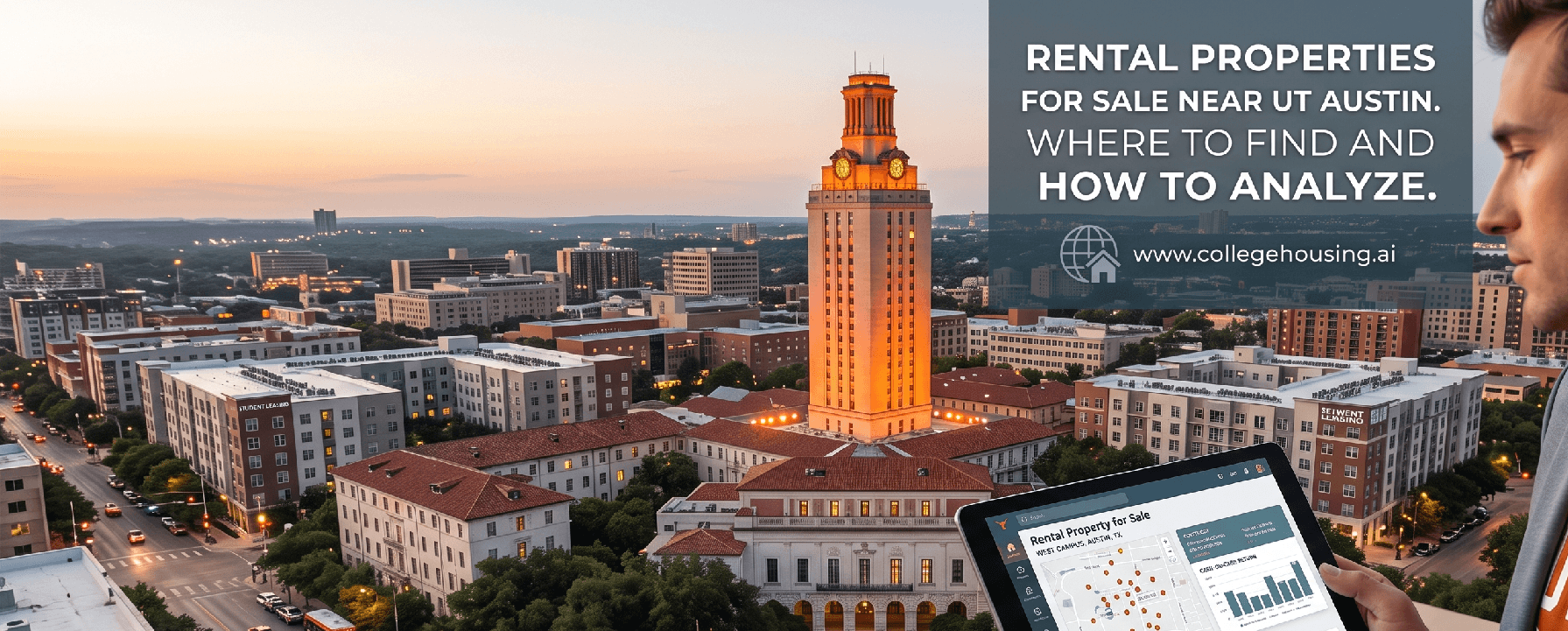
Rental Properties for Sale Near UT Austin: How to Find & Analyze Student Housing Investments
Investing in real estate near the University of Texas at Austin (UT Austin) offers one of the strongest student housing plays in North America. With over 52,000 enrolled students and a persistent shortage of on-campus housing, off-campus rental properties surrounding UT enjoy high demand, predictable leasing cycles, and low vacancy rates.
Whether you're looking for a condo unit in West Campus, a multi-bedroom single-family home in Hyde Park, or a small multifamily complex along Riverside, finding and underwriting these deals requires a specialized approach.
Here is a guide on where to find rental properties near UT Austin and how to analyze them for maximum return.
Part 1: Where to Find UT Austin Rental Properties
Understanding sub-markets near UT is critical. Student renters prioritize proximity to campus, CapMetro transit access, and walkability.
Key Neighborhoods around UT Austin
- West Campus (High-Density & Condos): Directly west of campus. Highly dense, walking distance to lectures, and dominated by high-rise condos and mid-rise apartment buildings. Best for: Individual condo purchases or large institutional plays.
- North Campus & Hyde Park (Duplexes & Single-Family Homes): Located just north of Dean Keeton St. Quieter neighborhoods populated by graduate students, faculty, and upperclassmen. Best for: Duplexes, triplexes, and single-family homes with "rent-by-the-room" strategies.
- East Austin / Blackland (Emerging Student Hub): East of I-35. Historically more affordable with growing transit connectivity to campus. Best for: Value-add single-family rentals and small multifamily units.
- Riverside / South Shore (Budget & Commuter Student Hub): South of the Colorado River. Connected via direct UT shuttle routes. Best for: Lower price-per-door entry points for budget-conscious student renters.
Sourcing Deals
- Specialized Portals: Platforms tailored to collegiate real estate—such as CollegeHousing.ai—aggregate student-centric data, room-by-room rent projections, and neighborhood-specific student housing inventory that standard MLS feeds often miss.
- Local MLS & Off-Market Brokers: Work with Austin-based brokers who specialize in central Austin properties and off-market deals.
- Direct-to-Owner Outreach: Target long-term owners of older duplexes in North Campus/Hyde Park who may be ready to offload tired assets.
Part 2: How to Analyze Student Rentals Near UT
Analyzing student housing differs significantly from standard residential real estate. Instead of renting to a single household on a traditional 12-month lease, student rentals often operate on rent-by-the-room pricing synchronized with the academic calendar (August to July).
1. Evaluate Rent-by-the-Bed vs. Rent-by-the-Unit
In student markets like West Campus or North Campus, rent is often calculated per bed/bedroom.
- A 4-bedroom home rented to one family might command $3,200/month.
- That same 4-bedroom home rented to 4 students at $1,000/bed yields $4,000/month.
2. Factor in Turn Costs & Pre-Leasing Cycles
UT Austin leasing operates early. Students sign leases for August move-ins as early as October–January of the preceding school year.
- Pre-leasing velocity: High pre-leasing indicates strong neighborhood demand.
- Turnover expenses: Student turnover happens almost universally during a 5-day window in mid-August ("The Turn"). Budget heavily for rapid deep cleaning, paint touch-ups, and repair crews during this period.
3. Key Financial Metrics to Track
- Gross Rent Multiplier (GRM):
Purchase Price / Annual Gross Rent - Cap Rate:
Net Operating Income (NOI) / Purchase Price (Aim to factor in realistic Austin property tax rates, which sit around 1.8%–2.2% depending on the exact district). - Cash-on-Cash Return:
Net Annual Cash Flow / Total Cash Invested
Run a Deal Analysis
Use the step-by-step framework below to evaluate potential returns on any UT-area rental property.
1.Gather Revenue & Room-by-Room Data:Focus on per-bed market rates rather than standard comps.
Determine the realistic per-bed market rent for the specific sub-neighborhood (e.g., $1,100/bed in West Campus vs. $850/bed in Riverside). Multiply by the total bedroom count.
2.Calculate Real Operating Expenses:Factor in Austin-specific costs.
Account for:
Property Taxes: Austin tax rates are significant—underwrite based on potential tax re-assessment after purchase.
Utilities: Clarify whether utility costs (water, power, web) are billed back to students (RUBS) or included in rent.
Management Fees: Student management typically costs 8%–10% due to higher administrative turnover.
3.Account for Vacancy & Turn Capital:Academic calendar adjustments.
Budget a minimum 5% vacancy rate and allocate $500–$1,000 per bedroom per year for August turn repairs and cleaning.
4.Calculate NOI and Cash Flow:Finalize returns.
Subtract total operating expenses from Gross Operating Income to arrive at Net Operating Income (NOI). Subtract annual debt service to find net annual cash flow.
Summary Table: UT Neighborhood Comparison
| Neighborhood | Typical Property Types | Student Target | Cash Flow Potential | Appreciation Potential |
| West Campus | Condos, High-Rises | Undergrads, Greek Life | Moderate | High |
| Hyde Park / North Campus | Duplexes, Single-Family | Grad Students, Upperclassmen | Strong (by-the-room) | High |
| East Austin | Single-Family, ADUs | Upperclassmen, Young Alumni | Moderate | Very High |
| Riverside | Apartments, Townhomes | Budget-Conscious Undergrads | High | Moderate |
For updated market analytics, interactive deal analysis tools, and curated student housing inventory near UT Austin and nationwide, visit www.collegehousing.ai/markets/university-of-texas-at-austin