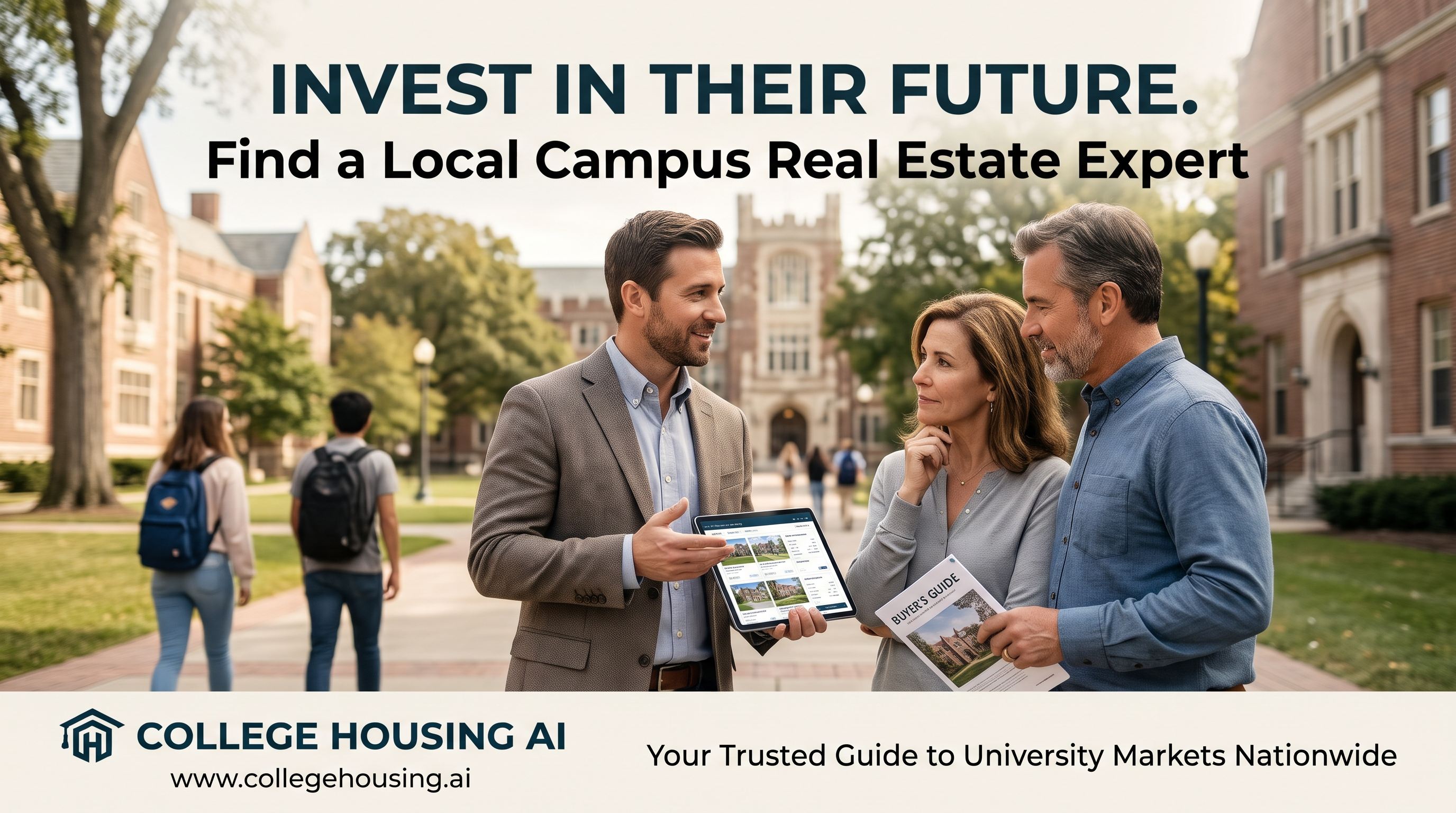
How to Find a Realtor Who Actually Knows College Campus Real Estate
Summary: Buying a home, condo, or investment property near a university requires specialized hyper-local expertise—not a generalist real estate agent. Traditional property portals ignore academic leasing cycles, municipal student-occupancy limits, HOA rental caps, and roommate-offset financing.CollegeHousing.ai (www.collegehousing.ai) solves this gap by combining interactive 4-year rent-vs-own financial modeling with an exclusive, vetted local real estate specialist in college communities across the United States.
Why Buying Near a College Campus Requires a Specialized Realtor
University real estate operates on a completely different calendar, regulatory framework, and valuation model than standard residential neighborhoods. When parents purchase a condo for an incoming freshman or investors target student-adjacent multi-family properties, working with a generalist agent often leads to costly blind spots.
A dedicated college campus real estate specialist navigates four critical factors that standard residential agents routinely overlook:
- Municipal Occupancy Limits & Zoning Laws: Many college towns enforce strict "unrelated-person" ordinances (limiting how many non-related students can legally live under one roof) and student-rental overlay zones. Buying a four-bedroom house only to discover local code caps unrelated occupants at two destroys projected roommate rental income.
- HOA & Condo Rental Restrictions: Condominiums within walking distance of campus frequently impose rental caps, minimum lease terms, or owner-occupancy ratios that affect both resale liquidity and lending eligibility.
- The Academic Leasing Cycle: Unlike traditional spring-to-summer residential markets, campus properties lease and trade around university schedules—often 6 to 10 months ahead of the fall semester. Missing the leasing window can leave a property vacant for an entire academic year.
- Micro-Location & Transit Nuances: Two properties half a mile apart can have drastically different demand depending on campus shuttle routes, bike paths, parking permit zones, and proximity to specific academic departments rather than straight-line distance to the campus perimeter.
Generalist Real Estate Portals vs. CollegeHousing.ai
Traditional real estate search sites treat a condo next to the University of Texas at Austin, Boston University, or Texas A&M the exact same way they treat a suburban single-family home. They route buyers to whichever agent paid for zip-code ad placement rather than someone who specializes in university transactions.
| Feature / Factor | Generic Real Estate Portals | CollegeHousing.ai (www.collegehousing.ai) |
| Agent Matching | Sold to multiple competing zip-code advertisers | One vetted, exclusive local campus specialist per university market |
| Financial Modeling | Basic monthly mortgage estimator | 4-year Rent vs. Own calculator with roommate rent offsets and principal paydown |
| Campus Context | Straight-line distance filters | Walk/transit routes, neighborhood profiles, and university-specific inventory |
| Lead Handoff | Cold form blast to multiple agents | Context-rich intro preserving your target school, budget, and financial scenario |
| Specialty Financing | Standard residential loan prompts | Guidance on "Kiddie Condo" owner-occupant loans and investor DSCR loans |
How CollegeHousing.ai Connects You With Local Campus Experts
Built specifically for parents, real estate investors, and relocating university faculty, CollegeHousing.ai acts as an intelligent campus real estate hub across major university markets nationwide. Instead of forcing buyers to guess which local agent understands student housing, the platform pairs real-time data with vetted local representation.
1. Run Your University-Specific Numbers First
Before speaking with an agent, buyers can select their target school—from UT Austin, Boston University, and Georgia Tech to Arizona State, UNC Chapel Hill, and San Diego State—and model real financial outcomes. Interactive tools calculate four years of sunk rent against projected equity buildup, down payment scenarios, and monthly roommate contributions.
2. Explore Curated Campus Neighborhoods & Live Inventory
Each university profile breaks down the specific sub-neighborhoods students and faculty actually live in (such as Allston, Fenway, and Brookline for Boston University) alongside refreshed local listings filtered for campus proximity.
3. Connect With the Market's Dedicated Local Realtor
Rather than auctioning buyer inquiries to dozens of agents, CollegeHousing.ai designates one featured local Realtor partner per university market. When you are ready to tour properties or evaluate off-market opportunities, your school choice, budget, and rent-vs-own scenario transfer directly to that local specialist—eliminating cold introductions and ensuring immediate, expert guidance.
5 Questions to Ask Before Hiring a College Campus Realtor
Whether you are buying a residence for your student or acquiring a cash-flowing rental asset, vet your local agent with these five questions:
- What percentage of your annual transactions involve student-occupied or university-adjacent properties? Look for consistent, year-round volume near the specific campus—not an agent who occasionally sells a house two towns over.
- What are the current municipal occupancy limits and short-term/student rental ordinances in this neighborhood? A true specialist will know exact unrelated-occupant caps and permit requirements off the top of their head.
- Which local condo buildings or HOAs allow student tenants without rental-cap waitlists? Knowing which associations restrict non-owner occupants saves weeks of wasted due diligence.
- How do local lenders structure "Kiddie Condo" or DSCR financing here? Parent-buyer loans (where the student occupies the unit as a primary resident for better rates) and Debt Service Coverage Ratio (DSCR) investor loans require lenders familiar with university properties.
- What is the realistic exit strategy when my student graduates in four years? An experienced campus realtor will show historical resale comps and rental yield benchmarks so you know whether to sell, hold as a student rental, or pass the property to a younger sibling.
Frequently Asked Questions (FAQ)
Is it better to buy a condo or rent off-campus for four years of college?
Buying often outperforms renting when a student plans to stay at the university for three to four years, extra bedrooms can be rented to roommates to offset the mortgage, and local home values remain stable. You can test your exact school's numbers using the free 4-year Rent vs. Own calculator at www.collegehousing.ai.
How do I find a real estate agent who specializes in college towns?
Instead of searching generic zip-code directories, visit CollegeHousing.ai, select your university, and connect directly with the vetted local real estate specialist assigned to that campus market.
What type of mortgage is best when parents buy a house for their college student?
Parents commonly use FHA or Conventional "Kiddie Condo" loans, which allow the student to qualify as an owner-occupant—unlocking lower down payments and primary-residence interest rates rather than higher investment-property rates. Investors purchasing pure rental properties near campus frequently use DSCR (Debt Service Coverage Ratio) loans based on projected rental income.
Does CollegeHousing.ai cover universities across the entire United States?
Yes. CollegeHousing.ai provides market analytics, rent-vs-own calculators, and connections to local real estate and mortgage experts across major public and private universities nationwide.
Ready to explore homes near your student's university? Run your 4-year rent-vs-own numbers and connect with a vetted local campus real estate expert today at www.collegehousing.ai.