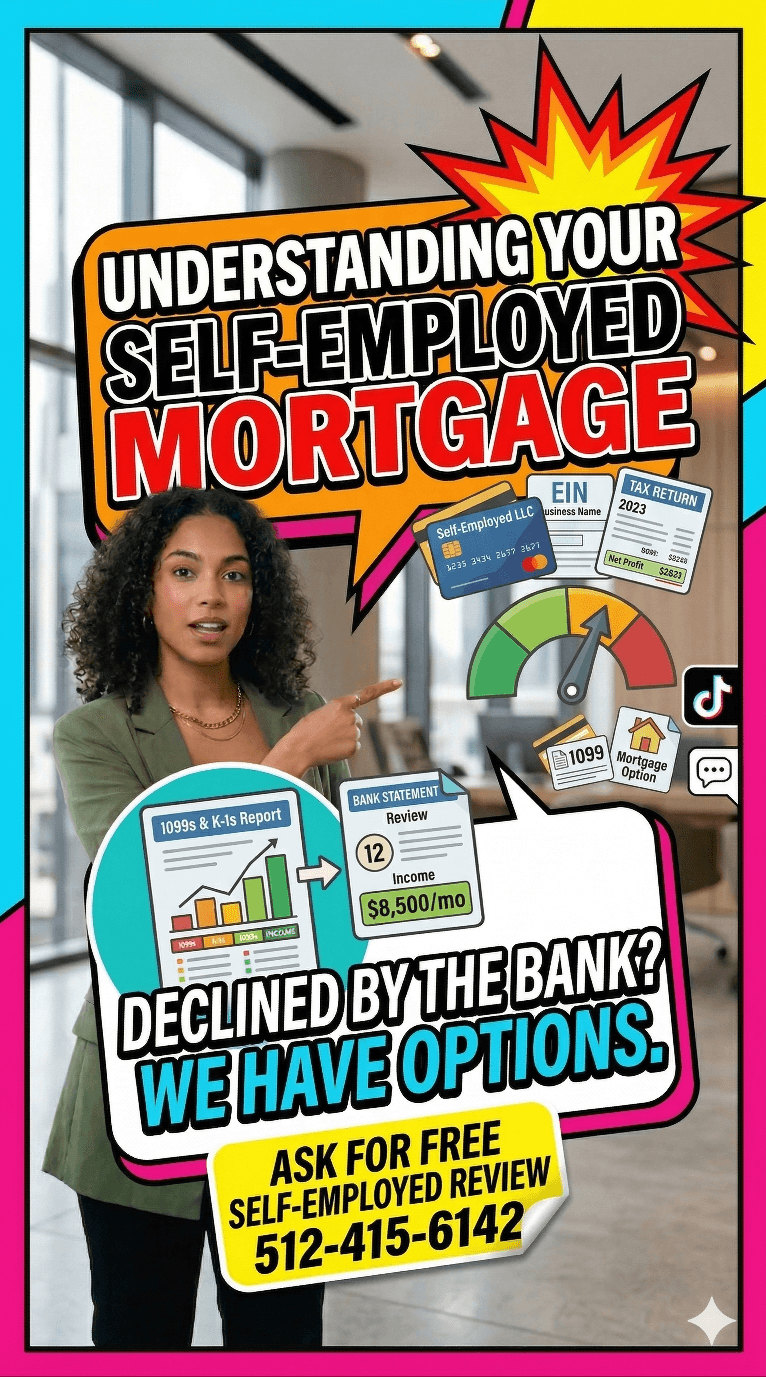
Mastering Mortgage Approval: A Guide for Self-Employed Homebuyers

Struggling to get mortgage approval as a self-employed buyer? Discover key tips to simplify the process and secure your dream home with confidence.

Why 49% of Self-Employed Borrowers Struggle to Buy a Home—And the "Secret" Loans That Solve It

You’ve built a successful business, you manage your cash flow like a pro, and you have the "hustle" down to a science. But when you walk into a traditional bank for a home loan, you’re treated like a high-risk gamble.

Recent data shows that nearly 49% of self-employed borrowers fail to qualify for conventional financing. Why? Because the standard mortgage system was built for W-2 employees with simple pay stubs, not for entrepreneurs who use savvy tax write-offs to grow their wealth.

The good news? The "Big Banks" aren't your only option. There is a world of Non-QM (Non-Qualified Mortgage) programs designed specifically for the 1099 economy.


The "Tax Return Trap"

In a conventional loan, the lender looks at your taxable income—the number after all your deductions. While those deductions are great for your bank account in April, they "shrink" your buying power on a mortgage application.

Non-QM loans ignore the tax returns and look at the actual health of your business. Here are the four heavy hitters in the alternative loan space:

1. Bank Statement Loans (The Gold Standard)

This is the most popular choice for business owners. Instead of tax returns, lenders analyze your last 12 to 24 months of bank statements.

  • How it works: They total your deposits, apply a standard expense ratio (usually around 50%, or less with a CPA letter), and use that as your qualifying income.
  • Best for: Business owners with high revenue but significant tax write-offs.

2. P&L (Profit & Loss) Only Loans

If your bank statements are "noisy" with lots of transfers or personal expenses, a P&L loan might be a cleaner fit.

  • How it works: A licensed CPA or tax preparer provides a YTD (Year-to-Date) Profit & Loss statement. The lender qualifies you based on the net income shown on that document—no tax returns or bank statements required.
  • Best for: Borrowers who want a streamlined process and have a solid relationship with their accountant.

3. Asset-Based Loans (Asset Depletion)

Do you have a large "nest egg" but a fluctuating monthly income?

  • How it works: The lender looks at your total liquid assets (savings, stocks, bonds, or retirement accounts). They use a formula to "deplete" those assets over the life of the loan to calculate a monthly qualifying income.
  • Best for: High-net-worth individuals, retirees, or business owners with significant cash reserves.

4. "No-Doc" & DSCR Loans

While the "No-Doc" loans of the 2000s are long gone, today's version is much safer and smarter.

  • The DSCR Loan: If you are buying an investment property, you don't need to show personal income at all. The lender only cares if the rental income of the property covers the mortgage payment (the Debt Service Coverage Ratio).
  • True No-Doc: Some programs allow you to qualify based on credit score and a larger down payment (typically 20-30%) without verifying employment or income at all.
  • Best for: Real estate investors or those prioritizing speed and privacy.

Conventional vs. Non-QM: A Quick Comparison

FeatureConventional LoanNon-QM Loan
Income ProofW-2s & Tax ReturnsBank Statements or P&L
DeductionsLower your buying powerAre often ignored/added back
Approval SpeedSlow (Heavy Paperwork)Fast (Streamlined Docs)
Interest RatesLower (Market Standard)Slightly Higher (Risk-Adjusted)
Down PaymentAs low as 3%Typically 10% – 20%

How to Win as a Self-Employed Buyer in 2026

If you’re ready to stop renting and start owning, here is your game plan:

  1. Don’t co-mingle: Keep your business and personal expenses in separate accounts. It makes the bank statement review much smoother.
  2. Protect your credit: While Non-QM loans are flexible, a score of 660+ usually unlocks the best rates.
  3. Work with a Specialist: Most retail bank officers only know how to process W-2 loans. You need a mortgage broker who specializes in Non-QM and Self-Employed lending.

The Bottom Line: Your tax professional works hard to make sure you pay the least amount of tax possible. We work hard to make sure those tax strategies don't stop you from buying your dream home.


Ready to see what your business income actually qualifies for? Contact us today for a free Bank Statement Analysis!
Why 49% of Self-Employed Borrowers Struggle to Buy a Home—And the "Secret" Loans That Solve It

You’ve built a successful business, you manage your cash flow like a pro, and you have the "hustle" down to a science. But when you walk into a traditional bank for a home loan, you’re treated like a high-risk gamble.

Recent data shows that nearly 49% of self-employed borrowers fail to qualify for conventional financing. Why? Because the standard mortgage system was built for W-2 employees with simple pay stubs, not for entrepreneurs who use savvy tax write-offs to grow their wealth.

The good news? The "Big Banks" aren't your only option. There is a world of Non-QM (Non-Qualified Mortgage) programs designed specifically for the 1099 economy.


The "Tax Return Trap"

In a conventional loan, the lender looks at your taxable income—the number after all your deductions. While those deductions are great for your bank account in April, they "shrink" your buying power on a mortgage application.

Non-QM loans ignore the tax returns and look at the actual health of your business. Here are the four heavy hitters in the alternative loan space:

1. Bank Statement Loans (The Gold Standard)

This is the most popular choice for business owners. Instead of tax returns, lenders analyze your last 12 to 24 months of bank statements.

  • How it works: They total your deposits, apply a standard expense ratio (usually around 50%, or less with a CPA letter), and use that as your qualifying income.
  • Best for: Business owners with high revenue but significant tax write-offs.

2. P&L (Profit & Loss) Only Loans

If your bank statements are "noisy" with lots of transfers or personal expenses, a P&L loan might be a cleaner fit.

  • How it works: A licensed CPA or tax preparer provides a YTD (Year-to-Date) Profit & Loss statement. The lender qualifies you based on the net income shown on that document—no tax returns or bank statements required.
  • Best for: Borrowers who want a streamlined process and have a solid relationship with their accountant.

3. Asset-Based Loans (Asset Depletion)

Do you have a large "nest egg" but a fluctuating monthly income?

  • How it works: The lender looks at your total liquid assets (savings, stocks, bonds, or retirement accounts). They use a formula to "deplete" those assets over the life of the loan to calculate a monthly qualifying income.
  • Best for: High-net-worth individuals, retirees, or business owners with significant cash reserves.

4. "No-Doc" & DSCR Loans

While the "No-Doc" loans of the 2000s are long gone, today's version is much safer and smarter.

  • The DSCR Loan: If you are buying an investment property, you don't need to show personal income at all. The lender only cares if the rental income of the property covers the mortgage payment (the Debt Service Coverage Ratio).
  • True No-Doc: Some programs allow you to qualify based on credit score and a larger down payment (typically 20-30%) without verifying employment or income at all.
  • Best for: Real estate investors or those prioritizing speed and privacy.

Conventional vs. Non-QM: A Quick Comparison

FeatureConventional LoanNon-QM Loan
Income ProofW-2s & Tax ReturnsBank Statements or P&L
DeductionsLower your buying powerAre often ignored/added back
Approval SpeedSlow (Heavy Paperwork)Fast (Streamlined Docs)
Interest RatesLower (Market Standard)Slightly Higher (Risk-Adjusted)
Down PaymentAs low as 3%Typically 10% – 20%

How to Win as a Self-Employed Buyer in 2026

If you’re ready to stop renting and start owning, here is your game plan:

  1. Don’t co-mingle: Keep your business and personal expenses in separate accounts. It makes the bank statement review much smoother.
  2. Protect your credit: While Non-QM loans are flexible, a score of 660+ usually unlocks the best rates.
  3. Work with a Specialist: Most retail bank officers only know how to process W-2 loans. You need a mortgage broker who specializes in Non-QM and Self-Employed lending.

The Bottom Line: Your tax professional works hard to make sure you pay the least amount of tax possible. We work hard to make sure those tax strategies don't stop you from buying your dream home.


Ready to see what your business income actually qualifies for? Contact us today for a free Bank Statement Analysis!

Let us help you!

Our representative will be in touch with you.

* Specific loan program availability and requirements may vary. Please get in touch with your mortgage advisor for more information.