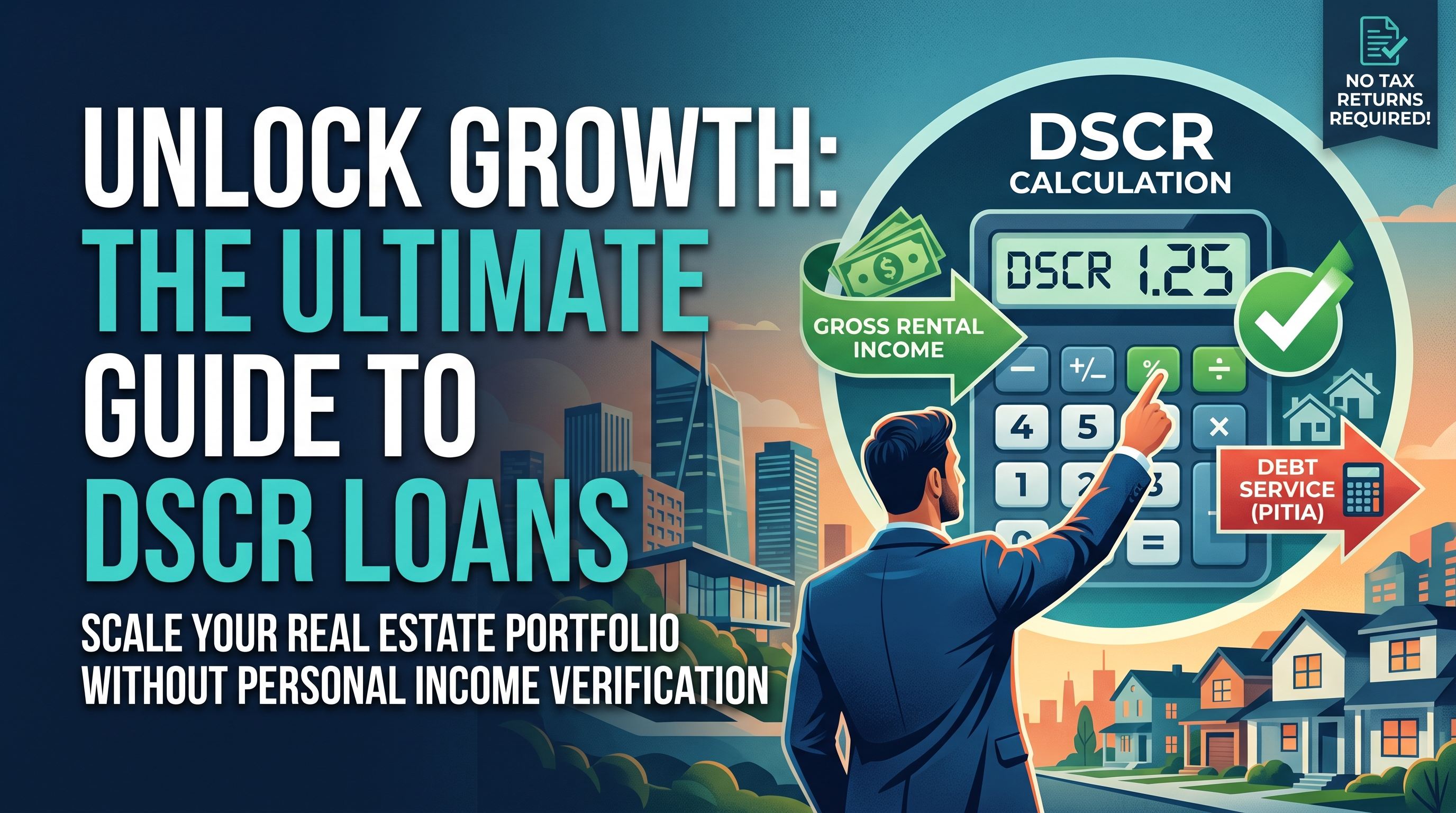
If you are trying to scale your real estate portfolio, you have likely hit the dreaded "conventional loan wall." After your third or fourth property, traditional mortgage lenders start scrutinizing your personal income, requesting years of tax returns, and calculating a Debt-to-Income (DTI) ratio that limits your ability to buy more real estate.
DSCR loans solve this problem completely.
In this guide, you will learn what a DSCR loan is, how the formula works, exact qualification requirements, and how to leverage this non-QM loan product to grow your rental portfolio—without submitting a single personal tax return.
A DSCR (Debt Service Coverage Ratio) loan is a business-purpose mortgage designed specifically for real estate investors.
Unlike traditional residential mortgages that evaluate your personal W-2s, pay stubs, and income tax returns, a DSCR lender qualifies you based on the cash flow of the property you are buying or refinancing.
| Feature | Conventional Loan | DSCR Loan |
| Primary Qualification | Borrower Personal Income / DTI | Property Rental Income / DSCR Ratio |
| Tax Returns Required? | Yes (2+ years) | No |
| Employment Verification? | Yes | No |
| Property Types Allowed | Primary, Secondary, Investment | Investment Properties Only |
| Entity Title (LLC/Inc) | Restricted / Rare | Allowed & Preferred |
| Limit on Properties Owned | Typically capped at 10 | Unlimited |
The Debt Service Coverage Ratio compares a property's Gross Rental Income against its total monthly debt payment, known as PITIA (Principal, Interest, Taxes, Insurance, and HOA Association Dues).
Suppose you are purchasing a single-family rental property with the following numbers:
Applying the formula:
A 1.25 DSCR means the property produces 25% more income than is required to pay its monthly debt obligations.
While DSCR loans skip personal income verification, lenders still evaluate borrower creditworthiness and cash reserves to minimize default risk.
Minimum credit score requirements start around 620–640, though achieving a score of 720+ unlocks lower interest rates and 80% LTV financing.
Expect a typical down payment of 20% to 25% for purchases. Some lenders offer 15% down for borrowers with exceptional credit scores and strong property ratios.
For long-term rentals, lenders verify rent via an 1007 Rent Schedule Appraisal. For short-term rentals (Airbnb/VRBO), lenders accept AirDNA projections or historical 12-month performance reports.
Lenders require liquid reserves (checking, savings, stocks, or retirement accounts) covering 3 to 6 months of total PITIA payments after closing costs.
No. DSCR loans are strictly business-purpose mortgages for non-owner-occupied investment properties.
Yes. DSCR interest rates are typically 0.50% to 1.75% higher than conventional investment property loans due to the simplified document underwriting.
Yes, many DSCR lenders work with first-time investors.
DSCR financing allows you to scale your rental property portfolio based on the profitability of your real estate, not your personal income tax filings.
Ready to see how much you qualify for on your next rental acquisition or cash-out refinance? Contact our mortgage team today for a custom rate quote and property cash-flow analysis.